


The Trust Gap
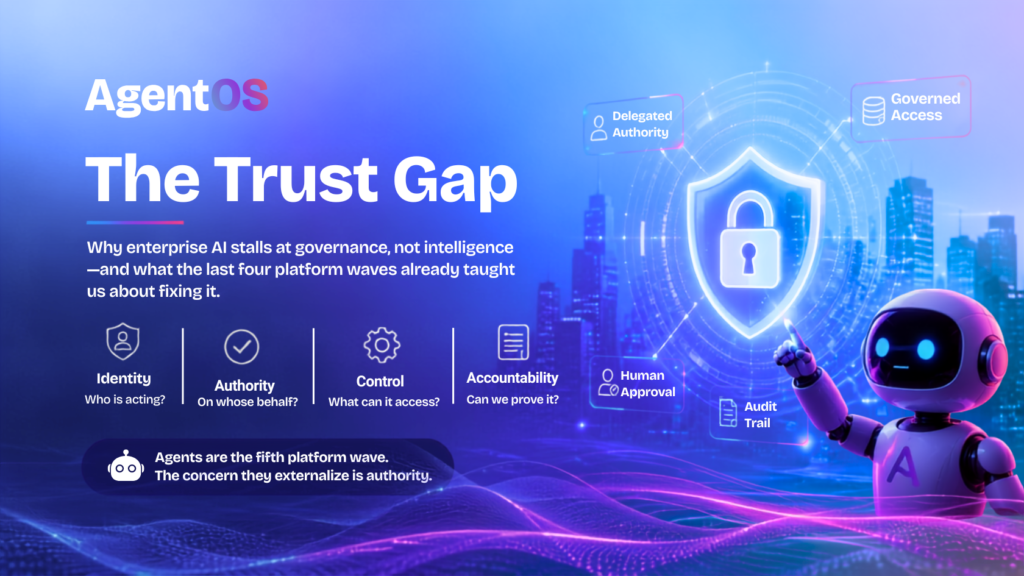
Why enterprise AI stalls at governance, not intelligence — and what the last four platform waves already taught us about fixing it
There is a conversation happening in enterprises right now that follows an oddly consistent script. A team builds an AI pilot. It works. It works well enough that someone senior sees it and asks the obvious question: can we roll this out? And then, somewhere between that meeting and production, the whole thing quietly stops moving.
Not because the model was disappointing — because a different set of people got involved: the ones who own risk. Who is this thing acting as? What can it reach? If it does something wrong at two in the morning, who finds out? These are the same questions any organisation asks before it gives a new employee a system login. Most AI pilots can’t answer a single one, because nothing in the stack was built to.
THE 90-SECOND VERSION
- The barrier to enterprise AI is no longer model capability — it’s trust: the inability to let autonomous software act without knowing who did what, on whose authority, and with what proof.
- Not a new problem shape. Cloud, microservices, data and durable workflows each forced a cross-cutting concern out of application code into a shared platform. Agents are the fifth wave.
- The concern agents force out is authority: identity, delegation, approval and accountability. An agent framework won’t solve it — a framework governs one agent, and the problem is an estate of them.
- What has to exist is an operating system for agents: identity, access, scheduling and an audit record, in one layer.
- This eleven-part series walks that layer end to end, one boundary at a time.
The barrier moved, and a lot of people missed it
For about two years, the honest constraint on enterprise AI was capability. That constraint has largely dissolved. Today a competent team can wire an agent to a business system in an afternoon, and the demo is genuinely impressive. Which is precisely the problem. The market isn’t waiting for enterprises to catch up. Gartner projects agentic AI spend will reach $201.9 billion in 2026 — and predicts more than 40% of agentic AI projects will be cancelled by 2027 over unclear value and weak risk controls. Same organisation: fast on capability, unprepared on governance. What made enterprise software safe was never that it was hard to build — it was that capability arrived slowly enough for control to be built alongside it. The friction was accidental, but the governance it created was not. Agents remove the friction and leave the governance behind — an engineer can grant autonomous software more reach in an afternoon than a new hire accumulates in a year, with no onboarding, no review, no record.
The gap is not between what AI can do and what we want it to do. It is between what AI can do and what we can prove it did.
A pattern the industry has already run four times
This shape is familiar: every wave of distributed, autonomous execution has pulled a concern out of application code and into a shared, enforced platform.
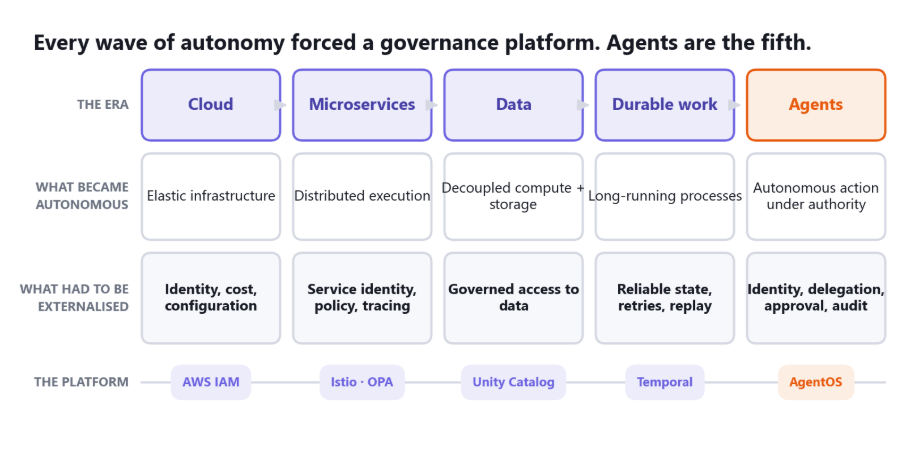
Cloud made infrastructure elastic, and identity and cost governance appeared to control it. Microservices distributed execution, answered with service identity and policy-as-code. Data platforms decoupled compute from storage, and governance became a catalog concern. Durable workflows made long-running processes reliable, and state became the platform’s job. Four times, the same move. Four times, the platform that named the concern became foundational infrastructure.
Agents are the fifth instance, and the concern they externalise is the one nothing before them had to handle: autonomous action taken under delegated authority.
| Era | What became autonomous | What had to be externalised |
| Cloud | Elastic infrastructure | Identity, cost, configuration governance |
| Microservices | Distributed execution | Service identity, policy, tracing |
| Data | Decoupled compute and storage | Governed access to data |
| Durable workflows | Long-running processes | Reliable state, retries, replay |
| Agents | Action under delegated authority | Identity, delegation, approval, audit |
That last row is the thesis: an agent framework, however good, cannot be the answer — the enterprise problem is an estate of them, built by different teams and touching regulated data. That is an organisation of non-human workers, and every such organisation has needed the same things: identity, least-privilege access, chains of command, approvals, and records — because scale plus autonomy without governance is indistinguishable from chaos.
What makes an agent genuinely different from a service
“Just treat it like a microservice” is a tempting shortcut, and it’s wrong in three specific ways.
A service does what it was programmed to do. An agent decides. Its behaviour is a function of a model, a prompt and whatever text arrived in the request — not enumerable in advance. Static review isn’t enough; you need runtime enforcement.
A service acts as itself. An agent acts for someone. When an agent calls the ledger, the honest answer is “the agent, on behalf of Priya.” If your system can’t express that, it can’t produce an audit trail anyone accepts, or apply the right permissions — those are Priya’s, not the agent’s.
A service is attacked through its interface. An agent is attacked through its input. Content an agent merely reads can carry instructions it then acts on. It has topped OWASP’s Top 10 for LLM Applications since inception, and only an enforcement layer outside the model fixes it.
That’s why governance for agents can’t be a policy document or checklist — it has to be machinery, sitting outside the agent, that the agent can’t argue with.
So what actually has to exist
Taken seriously, the requirements are derivable: an identity; borrowed authority rather than standing privilege; access enforced at the resource, not the interface; a human in the loop that survives a restart; governed data in and out; a record an auditor accepts. Put together, that is an operating system.
An operating system manages identity, schedules execution, mediates access, and records what happened — map that onto agents, and every box is filled. Kubernetes is the operating system for containers. Something has to be the operating system for agents.
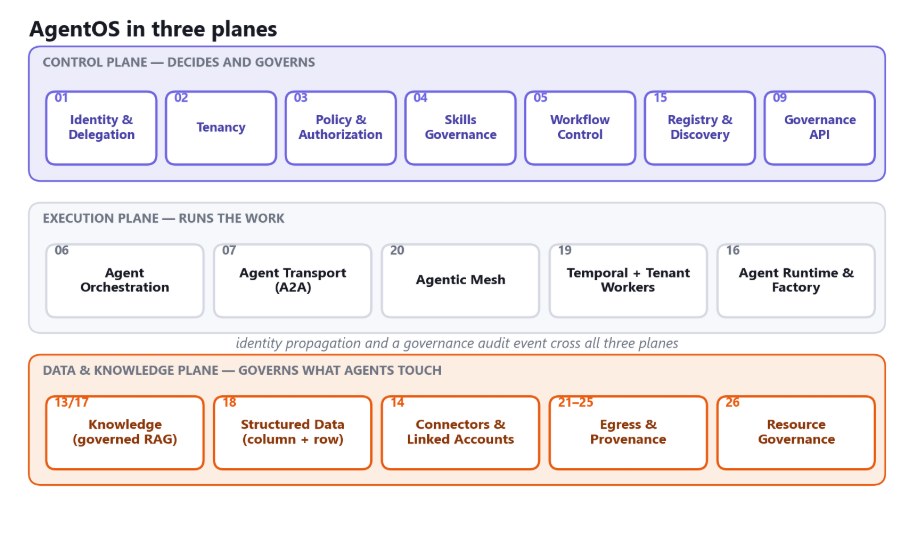
Three planes divide the labour:
The control plane decides and governs: identity, tenancy, policy, the registry — the authority for the audit record.
The execution plane runs the work — agents, the workflow runtime, the orchestration graph — calling back to the control plane for every governance fact.
The data and knowledge plane governs what agents may know and touch: governed retrieval, column- and row-level control, connector gates.
Crossing all three: identity propagation and an audit event for every action.
The one sentence that decides your architecture
If there is a single principle worth taking from this series, it is this:
Autonomous at the reasoning layer; deterministic at the orchestration layer.
Agents should be free to think: interpreting requests, planning, choosing between options. But they should not be free to act without control — execution must flow through a path that’s deterministic and recordable: identity check, policy decision, orchestration, audit event.
That separation is what lets a promise survive scale: fuse reasoning and execution, and at a thousand concurrent agents the honest answer to “what will it do?” is we don’t fully know. Keep them separate, and whatever it decided, it could only act through a path we control — without trading capability for safety, since you constrain the action surface, not the thinking surface.
What this series covers
Each part takes one boundary: what goes wrong without it, and what it costs.
- Part 2 — Every Agent Needs a Name. Identity and authority that only narrows.
- Part 3 — Least-Privilege by Construction. An enforced call graph.
- Part 4 — Durable Work, Human Judgment. Approvals that survive a restart.
- Part 5 — Acting As You, Not For You. The shared-service-account problem.
- Part 6 — Governing the Tools. Connectors, MCP, and key custody.
- Part 7 — Governed to the Cell. Data governed to the column.
- Part 8 — No Exit Is a Wider Door. The leak read-side controls miss.
- Part 9 — What the AI Costs, and Who Pays. Metering and budget ownership.
- Part 10 — What Shipped. The latest platform wave, explained.
- Part 11 — Own Your AI Operating Model. Verifiable portability, audit-ready proof.
Read in order, or standalone.
The question worth taking to your next AI review
Not which model are we using — that will change twice before production. Not which framework — teams will disagree, and they can all be right. Ask this instead: when this agent does something we did not expect, what exactly happens?
If the answer involves reading logs or trusting the agent’s own account, that’s a pilot — fine, but it won’t survive contact with risk owners. If it was structurally unable to act, stopped at a gate, or approved with a record of what was seen — you have something to run a business on.
The rest of this series is about how to get to that second answer.
WHAT TO TAKE AWAY
- Model capability is no longer the constraint — governance is, and it’s a platform problem, not a policy one.
- Agents differ from services: they decide rather than execute, act for someone rather than as themselves, and can be attacked through content they merely read.
- Requirements are derivable: identity, delegated authority, enforced access, human approval, governed data, an audit trail.
- Separate the reasoning layer from the orchestration layer. Let agents think freely and act only through a path you control.
- Judge any agent platform by one question: when something goes wrong, what structurally happens?
NEXT IN THE GOVERNED AGENT
Part 2 — Every Agent Needs a Name. If an agent acts inside your business, it needs an identity and borrowed authority, not its own — and why scope must only ever narrow.
Follow the rest of The Governed Agent series on the AgentOS blog, or visit nirvanaagentos.ai to see the platform this series is built on.